
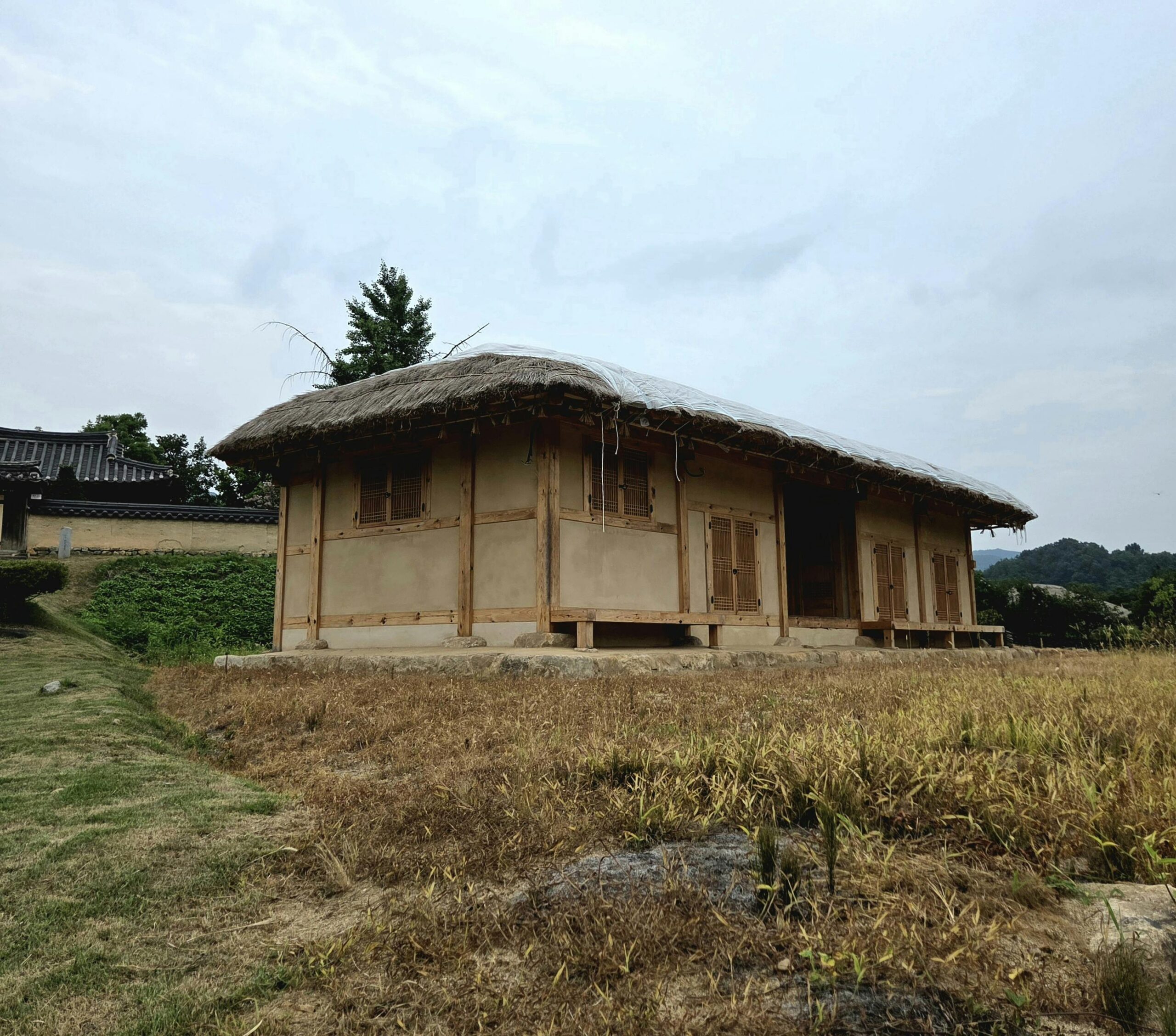
By Kerrie Kyde
In the classic English fairy tale, three little pigs build themselves houses, one of straw, one of sticks, and one of brick. The Big Bad Wolf comes along and, smelling dinner inside the houses, blows down the ones made of straw and sticks, but he can’t blow the brick house down. Attempting to reach dinner through the brick house chimney, he comes to a bad end, and the pigs escape. In these days of natural building, a wolf might still be able to blow down a house made of sticks, but he’d be no match for a properly-built straw house!
A modern straw house is built of straw bales, stacked on top of one another, the same way a dry-stacked stone wall is built, and pinned together vertically. The exterior of the bales is completely covered, generally with lime plaster. The interior is also plastered, often with clay, less often with a lime-based plaster. While strawbale walls can be weight-bearing, usually the bales function as insulation, stacked between wooden posts and beams which provide the structural support for the building. The bales and the plasters together form an air-tight, water-excluding sandwich with twice the ability to hold in heat compared to conventional stick-built buildings.
My husband and I got interested in strawbale building more than twenty years ago, when we took a class on how to build with straw and toured several bale houses in Colorado. We wanted to build a home and were exploring ways of reducing our carbon footprint. Natural building was a good way to limit our carbon production over the life of the home and its materials. Natural building, sometimes called sustainable or ecological building, is a design and construction process that promotes the use of sustainable construction techniques and locally-available natural materials. The materials used in natural buildings are those people have used for centuries to build dwellings—stone, earth, and plant materials. The building process is designed to produce energy efficient, healthy living spaces, while using recycled or salvaged and, ultimately, biodegradable resources.
Strawbale walls are eighteen or more inches thick and create houses that are warm when you need them to be, cool when you need them to be, and wonderfully quiet. Strawbale walls “breathe”; they keep currents of air and water out but allow water vapor to pass through. This means that on humid days, the straw and clay absorb moisture from the air, making the building interior more comfortable, and then release it as the interior air dries. Because the walls resist rapid changes in temperature, energy costs for heating and cooling are generally lower than for wood-framed houses.
Two questions that we learned the answers to right away about building with straw are: What about insects and rodents? and wouldn’t a strawbale house be a big fire risk? No worries. Straw is not hay. Hay is made from various grass species and includes the seeds of the grass, which certainly provide food for rodents and insects, as well as for mammals. Straw is what is left over after the grasses are harvested. What remains are the empty, dead, and dry grass stalks—not a big temptation for mice. When sandwiched together with appropriate plasters, strawbale walls are dense, tight, with very little air space inside them, and little to no food for critters of any kind.
These same characteristics—tight plaster and no air—are the reasons that bale walls meet international technical standards for fire resistance. Fire-tested bale sample walls resisted fire for two hours without failure, performing as well as or better than conventionally-built walls in fire conditions.
Although experiments are going on throughout the U.S. to produce modest, rapidly-erected strawbale housing; in general, strawbale houses are custom-built houses. They are about as expensive as conventionally-framed houses, but the input costs are reversed: You’ll pay less for materials and more for labor than for the same size stick-built house unless you build it yourself. If DIY is not for you,
finding the right skilled professionals can be challenging.
Our strawbale house was built with a combination of professional and DIY labor. We hired a builder with strawbale construction experience to build the frame and put up the walls. We sourced all the materials ourselves. We used stone, wood, and clay from the building site, and local suppliers and recycled components for things like the strawbales, interior doors, and the mudroom sink. My husband built all the windowsills, the stair treads, and the kitchen island countertop. I designed, mixed the pigments, and made sample boards for the various plasters. We hand-finished all the woodwork. Happily, a resurgence in interest in this kind of construction is going on throughout the U.S., with a growing cadre of both owner-builders and professionals. You can now order bale wall panels for a building, which are
factory designed and built and delivered to a site to be erected the same way factory-built conventional houses are.
Lest you think that these buildings might not hold up over time, consider this:
The oldest strawbale buildings in the U.S. stand in the Nebraska Sandhills region—it’s a hundred years old and still in use! The climate crisis is rapidly changing our world. We may not have wolves blowing our houses down, but we do have storms, wildfires, and rising energy demands. Homes built with local, widely-available natural materials, with superior heating and cooling performance, could help us adapt.
Published in Monocacy Monocle September 2025 Issue