
by Richard Strock
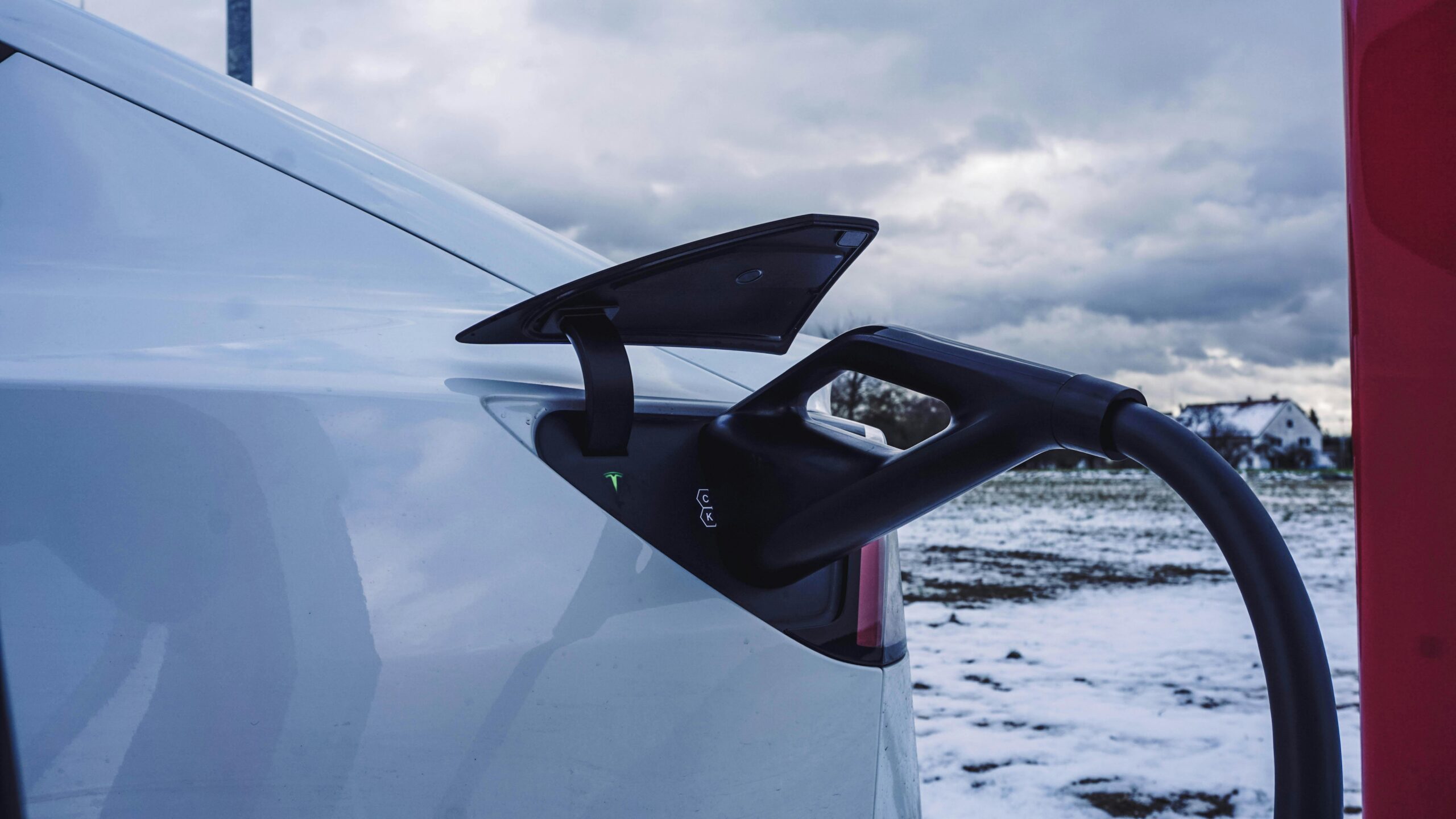
After almost 7 years of EV ownership, this past February, while returning home from San Diego, we experienced our first encounter with brutally cold temperatures (2°F), combined with snowfall and gusty winds. Driving a gasoline-powered vehicle in these conditions can be problematic, but driving an EV presents some unique challenges. Unlike a gallon of gasoline that burns hot regardless of the ambient temperature, EV batteries don’t deliver energy as efficiently in cold weather.
The item most impacted by the winter conditions we encountered is vehicle range – how far can one drive before needing to stop and recharge the battery? Everything in an EV is dependent on the energy stored in the battery. This article discusses some of the features designed into the vehicle to help manage that energy, and some techniques one can employ to extend the EV’s range. Some of these features and techniques were employed during the trip; others were not, either because they had been forgotten or were not readily available.
Some of the approaches that helped included:
- use of in-vehicle energy displays
- speed and management of energy-consuming features
- advantages of battery and cabin preconditioning
- available charging options.
Energy Displays
Many EVs offer real-time energy displays that show instantaneous energy consumption, projected range, and battery state-of-charge (SOC) upon reaching your destination or charging station. Some even provide real-time suggestions for extending the battery range. For example, when navigating to a destination, a warning will be displayed if the available energy is insufficient to reach your destination. If navigating to a charging station, it will recalculate and navigate to a closer station, assuming one is available. These estimates of available range are quite accurate, taking into consideration factors such as terrain, wind direction and velocity, your current speed, tire pressure, and auxiliary energy consumption such as cabin heating, power steering, and entertainment systems.
Management of Speed and Energy Consuming Features
High-speed driving, above 70 mph, is an important factor in the rate of energy consumption, if not the most important. If in danger of not making your destination or charging station, slow down! Monitor your state-of-charge estimate for your destination and lower your speed until you see the arrival state-of-charge value stabilize, or creep up. If necessary, turn off the cabin heat, running lights and entertainment system – anything that consumes electricity. This is especially important if your EV employs resistance heat, but less so if it uses a heat pump.
Battery and Cabin Preconditioning
To reduce charging time at DC Fast chargers, some EVs will precondition the high-voltage battery while navigating to the charging station. This is especially effective during cold weather. A cold battery cannot accept the high current that a DC Fast charger can deliver, resulting in longer charge times. Check your owner’s manual to see if your EV has this feature.
Preconditioning of the high-voltage battery and cabin before departing on a trip, long or short, is an effective way to reduce energy consumption. This is particularly effective if plugged into a charger, as the energy used for preconditioning is typically drawn from the charger instead of the high-voltage battery. The EV typically doesn’t need to be actively charging, just plugged in. Preconditioning of the battery is even effective when a charge cable isn’t connected. Batteries have a specific temperature at which they deliver energy most efficiently. If you precondition before you depart, the energy consumed during the initial portion of the drive will be delivered more efficiently, resulting in less wasted energy.
Charging Options
Preconditioning while on an extended trip can be problematic. I frequently forget to employ it in the rush to depart in the morning. Some EV apps allow you to schedule it ahead of time. I find that I’m more likely to remember it if we stay at overnight accommodations that offer EV charging. Many major hotel chains, including Hilton, Marriott, Hyatt, Best Western, and Holiday Inn, along with numerous smaller chains and independents, are offering EV charging at a growing number of locations, either Level 2 (overnight) chargers or co-located with DC Fast chargers. Staying at accommodations that offer or are close to EV charging facilities can be very convenient. Locating them can be a little challenging but getting easier as the proliferation of EVs increases. The PlugShare phone app provides details on virtually
all public chargers in North America. If one frequently uses Tesla’s Supercharger network the Superchargers app provides details about that network. Both apps allow users to post feedback about their charging experiences and can help one choose a charger that fits their needs.
Hotel chains are increasingly mentioning EV charging availability in their list of amenities. If you use apps such as Expedia, Kayak, or Choice, you may find EV Charging listed. Also, if you enter “EV charging…” followed by a location into Google Maps, it will provide the charging station location, details, user reviews and more.
Many EV’s advise against charging higher than 80%, then letting the battery sit overnight at a high SOC. One approach we use when staying at a hotel with charging facilities is to charge to 80% in the evening, then top off to 90-95% the next morning while loading the car and having breakfast. There are several different charging protocols in use across North America, and you may need to carry an adapter to take advantage all available charging options.
We use the Tesla Supercharger network almost exclusively when we travel. We find them reliable and conveniently located throughout the U.S. While planning a recent trip to Cape Breton Island, Nova Scotia however, we discovered there was only one Supercharger station on the whole of Cape Breton Island, and nowhere near where we were staying. We purchased a CCS-to-NACS adapter to take with us. To make sure it worked, and that I knew how to use it, I tested it at the DC Fast chargers located at Total Automotive & Diesel Services in Poolesville prior to our trip. We also had to load a couple charging apps on my phone, but the adapter worked flawlessly, and we had no issues charging while there.
Numerous manufacturers are converting their EV’s from CCS and CHAdeMO to Tesla’s NACS and have entered into an agreement with Tesla to use the Supercharger network. For information about eligible EV models and requirements visit: https://www.tesla.com/support/charging/supercharging-other-evs#find-supercharger.
Driving an EV in the winter brings with it some special challenges. But the good news is that it’s getting easier and easier to deal with these challenges as more and more EVs – and more and more EV chargers – are on American roads.
Published in Monocacy Monocle December 2025 Issue