
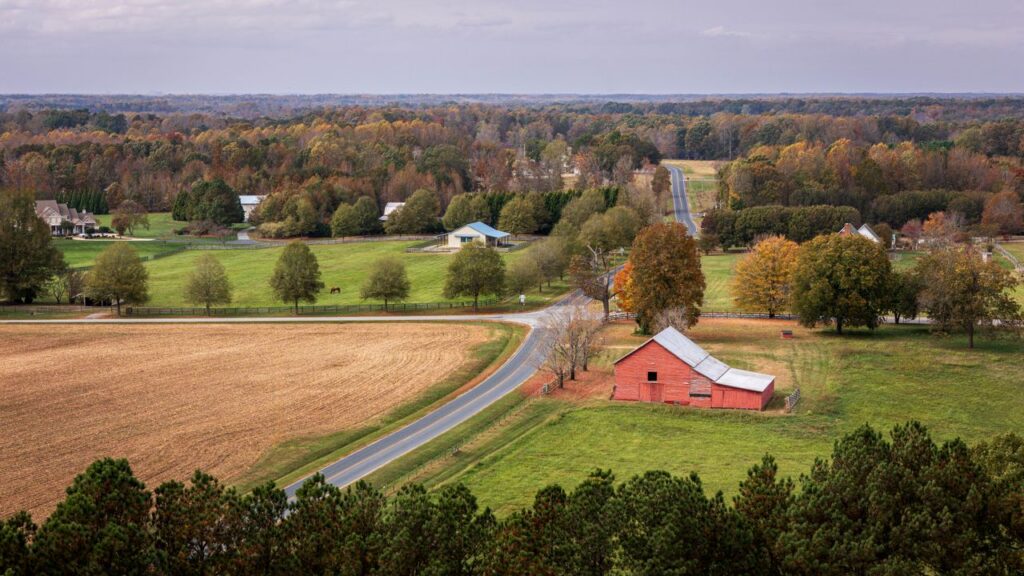
by Doug Boucher
My wife Charlotte and I live on a farm in Dickerson named White Acres that has been in her family for nearly two centuries. Although it has been in the same family all that time, what has been grown there has changed dramatically over the decades—and those changes reflect how Montgomery County agriculture has evolved during its long history.
The present farm was originally part of a plantation named Inverness, with several hundred acres on both sides of what is now Route 28. While we don’t know much detail about how the plantation was farmed, it’s clear that much of the work was originally done by enslaved African Americans, as was typical in Maryland in the early 1800s. With the Civil War bringing emancipation and the growth of the city of Washington, D.C., Montgomery County farms began to produce a diversity of food crops such as wheat and vegetables as well as livestock such as beef cattle, pigs, and chickens for the urban market.
Max White was born at Inverness in 1890 and wanted to farm on the family land like his forbears, but in a “modern” way. To do this, he went to Maryland Agricultural College—now the University of Maryland—and then spent a year working in Wisconsin, learning the most recent innovations in dairy farming. In 1916, he bought 177 acres of Inverness from his father, built a house on it, and moved in with his new wife Ellen White, naming the new farm “White Acres.”
The dairy farm prospered, and Max and Ellen were able to send their two daughters to study at the University of Maryland where he had gone. To help them pay the tuition, Max cut down and sold some large timber from the back side of the farm in the 1930s. A new forest grew up in the same place.
Although dairy farming was the main focus, Max and Ellen’s farm also produced lots of vegetables. During the Great Depression, Max’s sister Elizabeth would drive a load of produce to the Bethesda Women’s Farm Market every week.
Max decided to retire and sold off his herd in 1967, after a half a century of dairying. His daughters, both of whom had become schoolteachers, inherited the farm after Max’s death in 1972. They rented the land to neighboring farmers who used it to produce feed grains, generally rotating among corn, soy, and occasionally winter wheat.
The next generation of the family—my wife Charlotte and me, and Charlotte’s cousins—inherited White Acres in the 1990s and have continued to rent most of the cropland out for feed grain production. With my background in biology (I taught at Hood College for a decade), however, I have begun a couple of experiments in natural reforestation, with four acres starting in 2003 and another ten acres starting in 2023. The latter of these is creating a new forest that will eventually pay off the costs of establishing it, but in a different way than the trees that Max White sold during the Depression to send his daughters to college. He earned income by cutting his trees down; we have enrolled the ten acres in the county’s forest mitigation bank, so we’ll earn income by maintaining the forest and allowing it to grow forever.
Thinking over the history of our farm, I’ve been struck by how it typifies what has happened over time in the agriculture of all of Montgomery County, and indeed to some extent in all of Maryland—even our whole country. As the U.S. industrialized in the 1800s, cities grew rapidly and provided markets for farms just beyond their edges which could specialize in fresh products to feed their burgeoning populations. Some chose to concentrate on fruits and vegetables— what we now call “table crops”—while others focused on producing milk as well as the hay, pasture, and feed grains that fed their own cows. By the middle of the twentieth century, Montgomery County had over three hundred commercial dairy farms.
That was the high point. Since then, the local-food-for-nearby-cities model has broken down. This has been most dramatic with dairy, which has steadily declined in our region through the rest of the twentieth century and the first quarter of the twenty-first. Now, depending on how you count them, Montgomery County has just one to three commercial dairy farms remaining. Our milk comes from Pennsylvania, Wisconsin, or even California, taking advantage of refrigeration and railroads.
A similar process has happened more recently with fruits and vegetables. Our county had about nine hundred acres in these crops at the turn of the twentyfirst century, but since then, their area has shrunk to less than half that much. What has replaced these traditional commodities on our local farms? Overwhelmingly, our land is producing feed rather than food: corn, soy, hay and pasture. To the degree that the crops are changing, they are just reinforcing this pattern. This past year, for example, just in driving from Dickerson to Gaithersburg, I’ve seen four different fields of a new crop: sorghum. In some parts of Africa, sorghum is a basic food for humans, but here it is simply a different kind of feed grain.
Doesn’t all this feed production, which takes up over seventy percent of the county’s farmland, go to nourish the animals whose meat and milk we eat? Not in Montgomery County. The kinds of livestock that we consume have declined over recent decades in parallel with the drop in dairy and table crops. The numbers of beef cattle, dairy cattle, goats, sheep, and pigs raised in the county have all gotten steadily smaller over the past two decades. The only kind of livestock whose numbers have stayed large is horses—which we keep not for food but for recreation.
In the present day, our farmland overwhelmingly produces the horses that we ride and the feed crops that they eat—and one other thing: trees. Forests, which had nearly all been cleared in the eastern U.S. by the Civil War, have grown back and now cover about seventy-five percent of the land. It’s less in Montgomery County, but forest still covers about a third of our county’s area.
Bio tag: Doug Boucher, a retired climate scientist, is the President of Poolesville Green.
Poolesville Green column for the Monocacy Monocle