By Doug Boucher
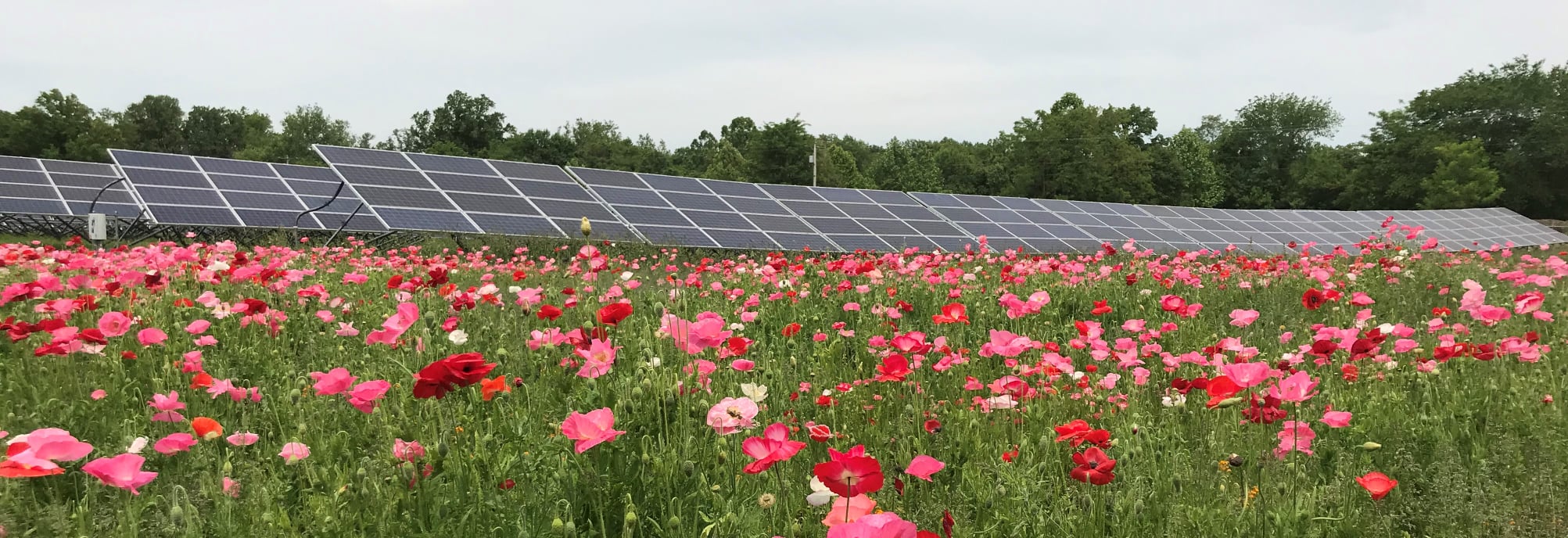
In 2013, the Town of Poolesville became the first town in Montgomery County, and only the third in the state, to create its own renewable energy system. Located next to the municipal wastewater treatment plant on the town’s eastern edge, the five-acre solar array was relatively small, generating just 1.13 megawatts of power. Yet that was enough to satisfy ninety percent of the needs of all the town government’s activities.
Next to the solar array is a pollinator meadow that brightens the landscape throughout the growing season, from scarlet poppies in the spring to yellow goldenrods in the autumn. Likewise, the grassy vegetation under the array is also perennial; it covers the soil all year long, preventing erosion. The construction and management of the array was a public-private partnership, joining together the town government’s efforts with contributions from Standard Solar, UGI Energy Services, and Also Energy. One helpful feature of its conception was a commitment to transparency, so that Poolesville’s citizens
(and anyone else in the world who has access to the web) can check how it’s doing in real time. Just go to the town website at www.poolesvillemd.gov/298/Solar-Power and click on the “See how the solar array is performing” link, and you can see the amount of power being produced, right now or all the way back to the first electrons generated in 2013.
I happened to do that on Poolesville Day this year and found a remarkable coincidence. It turned out that on that day, the total electricity generated by the array in 2025 had just reached one billion watt-hours. Since it went online in December 2013, Poolesville’s array has created almost sixteen billion watt-hours of clean renewable power.
That’s just a dozen years ago, but in terms of renewable energy technology, it’s practically the Stone Age. Since then, there has been a phenomenal increase in solar, wind, and geothermal generation, accompanied by advances in related parts of the energy system like battery storage and electric vehicles. The cost of solar energy has dropped dramatically, from twenty cents per kilowatt-hour in 2013 to just four cents last year. The panels that capture the sunshine are now much more efficient (as well as considerably cheaper), but it’s not just the hardware that has progressed. The software is better too, so that the new state-of-the-art panels change their tilt throughout the day to keep facing the sun—like sunflowers!
There’s still room for old-school solutions as well. The town array is periodically grazed by sheep, keeping the vegetation below the panels at a reasonable height and generating income for local farmers. This maintains the perennial vegetation that keeps the soil covered, unlike conventional corn-soy production that may expose bare ground much of the year, leading to erosion and carbon dioxide emissions.
The town’s solar array is one of many innovative clean-energy steps taken by Poolesville. Other examples include our LED streetlights, the electric vehicle (EV) chargers, the solar panels on the roof of St. Peter’s Church, and the EV show on every Poolesville Day. The progress continues: Elements of government like the Sustainable Poolesville Committee, the Montgomery County Green Bank, and the PHS Global Ecology Program, are working with nonprofits such as Poolesville Green to lead the way.
When you turn on the lights or drink a glass of water in Poolesville, take a second to thank the sun. To borrow a phrase from the environmental group CCAN, it’s 4.6 billion years old and still going strong.
Doug Boucher, a retired climate scientist, is the president of Poolesville Green.